/
/
Charitable Remainder Trusts

Charitable remainder trusts: income today, a gift that outlasts it

A charitable remainder trust (CRT) lets a donor turn appreciated assets into an income stream, manage the tax on their sale, and direct what remains to the causes they care about. This is a plain-English overview of how CRTs work, who they suit, and when they do not fit.

What it is

An irrevocable trust with two beneficiaries: people first, then charity

A charitable remainder trust lets a donor transfer appreciated assets into the trust, receive income for life or a set term, and direct the remaining value to one or more charitable organizations.

CRTs are governed by federal tax law and must meet specific requirements, including minimum payout rates and charitable remainder thresholds. Properly structured, a CRT can be part of a broader charitable, income, and estate planning strategy.

The two primary types
CRAT

Charitable remainder annuity trust

Pays a fixed annual amount, set when the trust is created.

CRUT

Charitable remainder unitrust

Pays a percentage of the trust’s assets, recalculated every year.

A couple reviewing planning documents with their advisor across a conference table.

Donors usually work through CRT scenarios with their financial, legal, and tax advisors before anything is signed.

An advisor holding a printed document in her office.
Who uses one

Most often, people with an appreciated asset and a plan for it

CRTs are most often used by individuals who:

Own highly appreciated assets, such as stock, real estate, or business interests

Are planning a sale or liquidity event and want to manage tax exposure

Want ongoing income rather than a one-time distribution

Want to support charitable organizations in a meaningful and lasting way

Are building philanthropy into long-term financial or estate planning

A CRT is not right for every situation. It works best when it is matched to the right assets, goals, and planning horizon.

Why donors choose it

Seven things a CRT can do

Each of these depends on how the trust is structured and on the donor’s overall financial situation. None is automatic.

Defer capital gains

Avoid immediate capital gains recognition when appreciated assets are sold inside the trust.

Diversify

Convert illiquid or concentrated assets into a diversified portfolio.

Create income

Set up a rules-based income stream for life or a defined term.

Take a deduction

Receive a charitable income tax deduction in the year the trust is funded.

Give and keep income

Support one or more charitable organizations while retaining income benefits.

Provide for others

Provide ongoing income for a spouse or other designated beneficiaries.

Leave a legacy

Create a lasting philanthropic legacy aligned with personal values.

A retired couple walks along a beach boardwalk at sunset
How it works

Assets in, income out, remainder to charity

A high-level view of the sequence. Before a CRT is established, donors typically review planning scenarios with qualified financial, legal, and tax advisors to confirm it fits their long-term goals.

Start
1

The trust is created

A charitable remainder trust is drafted and executed in accordance with IRS requirements.

2

Assets go into the trust

The donor contributes appreciated assets to the CRT.

3

Assets may be sold inside it

Because the CRT is tax-exempt, the sale does not trigger immediate capital gains recognition.

4

Income is paid out

The trust makes distributions to beneficiaries on the payout terms set at creation.

End of term
5

The rest goes to charity

At the end of the term, the remaining value passes to the designated charitable beneficiaries.

Results vary. Depending on investment performance and trust design, the total income paid to beneficiaries plus the amount charity receives may exceed the value of the assets originally contributed. Market conditions, payout rates, and trust terms all affect the outcome.

Common misconceptions

You do not hand over your financial life

The most common worry is that a CRT means giving up control. In reality, the donor sets the key terms at the outset. The trust is then administered to fiduciary and legal standards.

Not a tax shelter. A CRT is a structured strategy governed by clearly defined rules.

Not a guaranteed income product. Payouts follow the trust terms and the trust’s assets.

Not a short-term tool. It is built for long-term objectives.

What the donor decides up front

These elements are set when the trust is created, and they shape everything that follows.

Decided by the donor
Payout terms
Income beneficiaries
Trust duration
Charitable recipients
FAQ

Frequently asked questions

Have a client-specific question? Call 727-531-0058 or email in**@********cf.org. A real person answers.

Grandparents laugh with their daughter and granddaughter on a porch

What is a charitable remainder trust?

An irrevocable trust that provides income to one or more beneficiaries for a period of time, with the remaining assets ultimately benefiting one or more charitable organizations.

Donors with highly appreciated assets who want income, charitable impact, and tax-efficient planning as part of a broader financial strategy.

Income is paid according to the trust’s payout structure: either a fixed amount (CRAT) or a percentage of trust assets recalculated annually (CRUT).

Common assets include publicly traded stock, real estate, business interests, mutual funds, ETFs, and other appreciated property.

A CRT can offer several potential advantages, including:

  • Avoiding immediate capital gains recognition on appreciated assets
  • Creating a structured, rules-based income stream
  • Receiving a charitable income tax deduction
  • Supporting charitable organizations
  • Providing income for a spouse or other designated beneficiaries
  • Potential estate planning benefits when properly structured

The specific advantages depend on the donor’s goals and circumstances.

A CRT may not suit donors who need immediate access to their assets, do not hold appreciated assets, or want a short-term or reversible planning solution.

Want the full, in-depth guide?

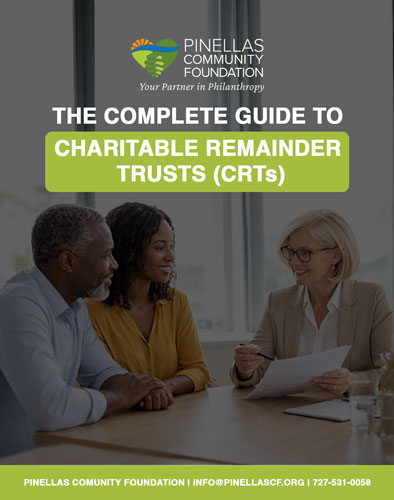
The Complete Guide to Charitable Remainder Trusts

This page is an overview. For deeper analysis, advanced planning scenarios, and detailed explanations, Pinellas Community Foundation publishes an extended guide covering advanced CRT strategies, asset-specific considerations, and planning nuances.

Cover of The Complete Guide to Charitable Remainder Trusts (CRTs) from Pinellas Community Foundation.

Download the Complete Guide to Charitable Remainder Trusts (PDF)

A comprehensive reference covering advanced CRT strategies, asset-specific considerations, and planning nuances.